Written by: Zahara Abedin
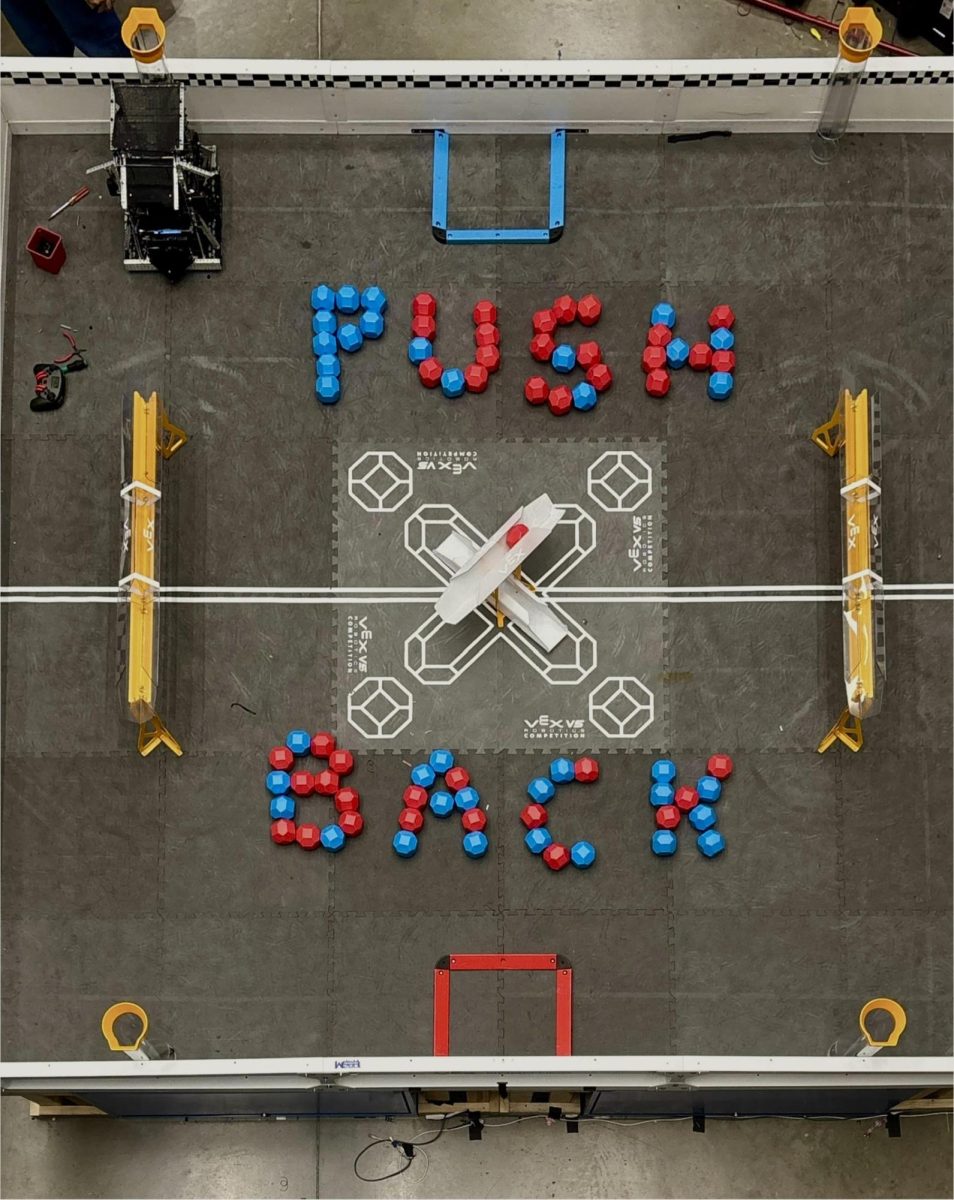
What would you say if asked, “How to get a block in a goal”? Now, before a simplistic answer arises in your mind, you have regulations. The goals are elongated tunnels, short and tall, and your team’s robot, built from 0, is the only object allowed to move the blocks. Oh, and one more thing to mention, it’s a competition against two other teams to have your designated color block score the most. The challenges described are the framework of the 2025-2026 VEX game Push Back that Lovejoy Robotics students are trying to solve this year.
The question remains, what are these students going to do now?
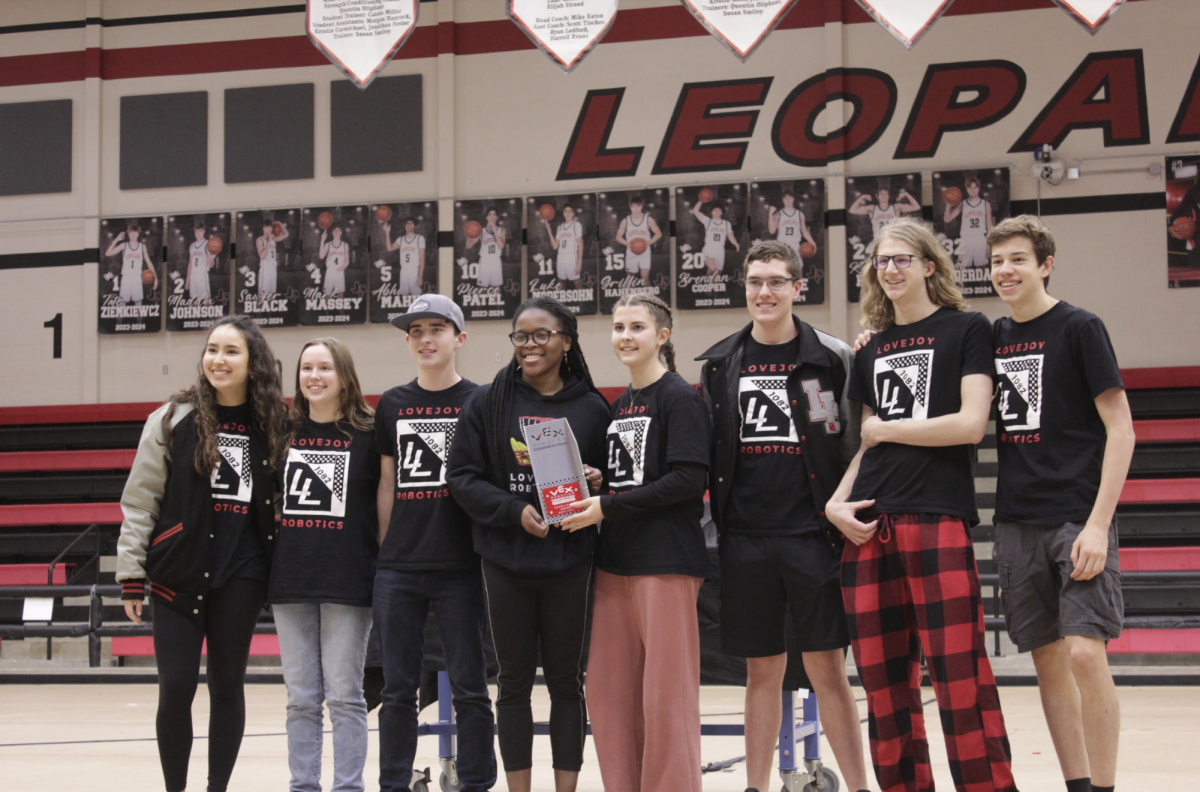
First, it’s essential to acknowledge the previous success of Lovejoy Robotics and finally shed light on these outstanding achievements. In some context, last year’s VEX Robotics Game was Highstakes, which inquired, in summary, scoring rings on alliance stakes and mobile goals. The ultimate challenge was hanging off the center ladder and the thrill of scoring at the highest stake, which was 42″ tall, all through the skills of students and their robot. However, no matter how difficult, rings and stakes didn’t stop Lovejoy Robotics students and their outstanding performance. Throughout the entire season, two teams won Tournament Champions at Robotics 5A UIL, and the organization won 7 awards at both Wave and Kalahari Signature events (2x Design awards, 2x Think Awards, 3x Finalist, and 4x top 6 Skills Ranks). At Regionals, Lovejoy Robotics won the Excellence Award, Tournament Champions Award, Design Award, Innovate Award, and Create Award. The most impressive was the World Awards won by the 1082 teams. VEX Robotics Worlds is when over 800 teams from across the globe come together and compete against one another in hopes of making it to the final round. Qualifications are required to make it to VEX Worlds to prevail in the first place, and a series of matches determines who makes it to the finals and wins the whole competition. That day, Lovejoy teams brought home the Innovate Award by 1082S and the Build Award by 1082E.
These accomplishments were solely last year, so we can highly predict teams putting the speed to the max in this year’s Push Back Season. The overview for this year’s game will have 88 blocks on the field, with 44 being red and 44 being blue. On the field, four matchload positions are on the walls where students must strategically remove the blocks from the goal utilizing their robot’s mechanisms. Other blocks will be intentionally placed around the field before the game begins. The mission is to take your designated color block and score in the goals (two long goals and two center goals). But, there’s a catch. The long goals are tunnels that an opponent can push through from any side throughout the game, and to score the most in the goals, a designated section of the block has to be positioned precisely. Additionally, there are parking zones where the robot is required to be stationed before the match ends to earn 30 points. As simple as this may seem, strategy, skill, trials, and teamwork are significant to winning the matches and performing best.
However, that is just the bare minimum that meets the requirement for an award. To qualify for an award, teams must document the design and build process of the robot, along with team decisions from start to finish. Additionally, teams need to have a well-rounded interview with the judges and excellent execution in performance to qualify for high rankings in awards of Excellence, Design, Innovation, Think, and many more to follow. This means that there is a job for everyone on a team.
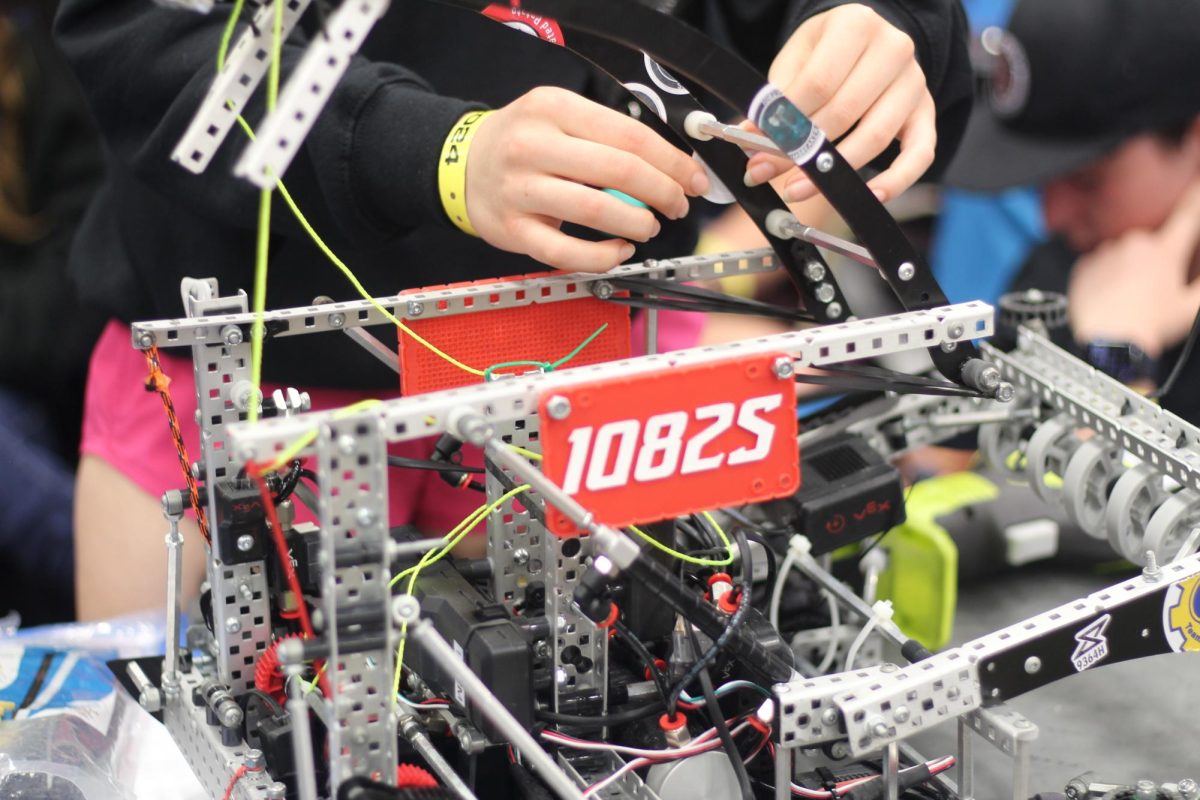
To recap, the leading roles each team has are builder, programmer, notebooker, and project manager. The builders come together to design, compose, and test the robot that follows the game rules. The programmer codes the robot to ensure execution follows well, especially during the autonomous period, where the robot moves only through pre-programmed code. The notebookers document the whole process. That documentation needs to be thorough enough to start from nothing and build the team’s current robot (a lot of work, right?). The project manager sets dates and keeps the team on track. Obviously, there are also other roles like the team captain and drive box group that all fit together like perfect puzzle pieces as a team.
Knowing your curiosity, students were asked what they enjoy the most about their role, why it’s significant in the team dynamic, and how much time they put into it.
Zeynep Kaya, a notebooker on 1082J, passionately explains, “The things I love about notebook are working with the other girls in my teams, as they are just as committed as I and match my competitiveness …also because I can work from home. The significance of a notebook is to document every little thing about your process. This helps the team win awards and show judges how your team got to the current design and how the team and robot grew and evolved over time. [As a notebooker] we have to keep pace during the season as changes are being made…it definitely does take a lot of time but super rewarding”.
Nolan Finnigan, a Programmer on 1082J, says, “I enjoy learning new theory and developing new algorithms. [My significance is] I help keep people on track and push them to new heights to make a bot that can do everything I want for code. Last year, the [time commitment] was a lot more because I had to fit a lot of tuning into a few days”.
Another Programmer on 1082E, Carson Dykstra, explains his take: “I enjoy being able to solve problems, develop designs, and work closely with my friends. [My significance is] I act to keep everyone on track to some degree. [My time commitment is] lunch, leopard time, and after school is probably around 2 hours per day”.
Deacon Frauman, a Builder and Driver on 1082J, explains, “I get the fun part of driving the robot. [However,] just because I get the fun part, doesn’t mean I don’t put in any work. I also build and design. Driving goes hand in hand with function. [My time commitment is] around 20-35 hours a week”.
James Bognot, a Builder on 1082E shares, “I love starting from a pile of scrap screws and metal and being able to turn that into a working robot. I really enjoy seeing designs coming into fruition. Being a builder is a really important part of the overall design process because both coding and documenting directly rely on it. Making sure build is done on time is really important as to not cause unneeded stress. I usually spend 6-7 hours in the lab at a minimum weekly, and more time outside brainstorming design and build fixes”.
Valentina Dias, a Notebooker and Project Manager on 1082W, says, “What I enjoy most about being a notebooker and project manager is getting to document our team’s entire journey. I find it really rewarding to see how every idea and test adds up to the finalized robot. As the notebooker, I document everything that happens with the robot so we have a clear record of our progress and reasoning throughout the season. And as a project manager, I make sure everyone stays on task and that we’re communicating effectively to hit our goals. It definitely takes a lot of time. Since I’m also in varsity lacrosse and other extracurriculars, balancing everything is tough, but I’ve learned how to manage my time. I spend hours updating the notebook, and making sure everyone’s on track”.
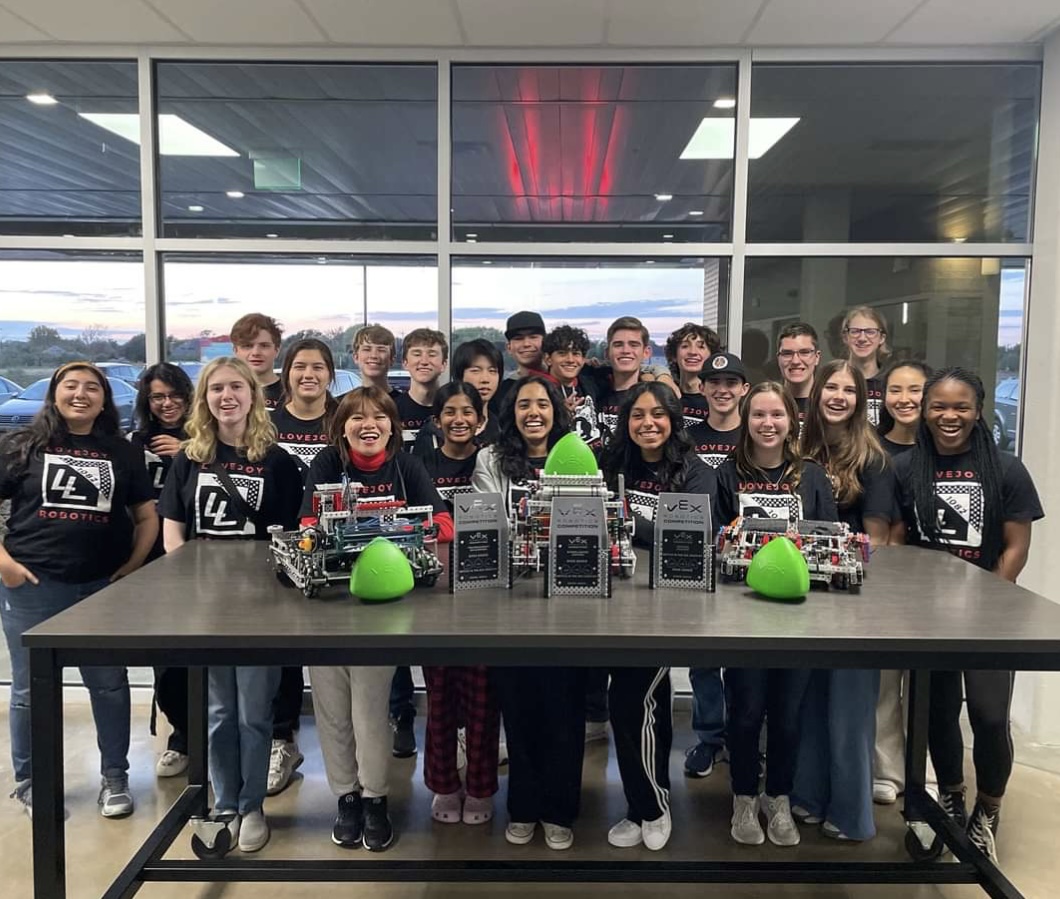
In Lovejoy Robotics, eight teams are divided by levels: 4 Varsity, 2 JV Black, and 2 JV Red. The varsity teams are 1082E, 1082J, 1082M, and 1082W.
On 1082E Carbonated Potato has Nick Verschage, Nick Amabile, Carson Dykstra, James Bognot, Justen Mao, Lily Helfand, Mary Sheridan, and Zahara Abedin. 1082J Jumbo Shrimp includes Carson Miller, Nolan Finnigan, Lucas Hersley, AJ Hersley, Deacon Frauman, Colt Whitfill, Zeynep Kaya, Siddhi Pareek, and Manna Jagarlapudi. 1082M Meltdown has Lucas Baldwin, Zayan Alam, Keshav Subash, Arthur He, Curtis Cook, Christian Vilaysack, and Catie Pruitt. On 1082W, Wild Card are Valentina Dias, Isaac George, Zachary Adell, Christian Fiorello, Tyler La Grace, Tyler Valentine, Matthew Yin, and Jacob Zhu. Throughout the year, these varsity teams will mentor the 2 JV Black teams, 1082U and 1082N, and the 2 JV Red teams, 1082T and 1082V.
Lovejoy Robotics is already on the move with upcoming events, some of which are in less than a month. The most recent, significant one coming is the annual For the Love of Bots competition hosted by Lovejoy on November 1st, where Lovejoy and other surrounding teams compete against one another. We hope to see you there, but you can always make it to the second For the Love of Bots in February to see the fantastic teams. Important signature events are Speedway, where Lovejoy teams travel to Indianapolis and Robot Rodeo in Dallas. Local competitions are at Wylie, Garland, Southlake, Wichita, and Fort Worth, so don’t miss out on the teams’ skills in action!
At the end of the day, the robotics program isn’t just any ordinary extracurricular. The program teaches real-world skills and problem-solving experiences that students build progressively. Understanding how to work with others, experiencing interviews from judges, and coming together to design and develop a robot fosters hands-on experiences and strengthens real-world expertise for student growth. Lovejoy Robotics encourages action-based learning, equipping individuals to think and perform like engineers.
“Robotics has allowed me to grow through means of competition; it has inspired me to grow alongside my peers in many ways, such as communication, problem-solving skills, and leadership,” states Alex Vester on 1082U.
“I gained experience in building and working with others. This is my fourth year in robotics, and working with a team of people who all have different specialties is super beneficial for future jobs and even school projects right now,” Lucas Baldwin on 1082M explains.
Though it is only the beginning of this season, anticipation arises about what these students will accomplish this year. The journey is only starting for them, so be a part of their story, as you may learn something valuable along the way. If you want to empower the next generation of robotics minds, join the innovators, and get the inside scoop for what’s next, check out their website, lovejoyrobotics.com, for more information, or visit the lab B121. As for now, though, it’s Gears in Reverse–the Push Back Season– a program for patience and progression for every student who refuses to give up.